

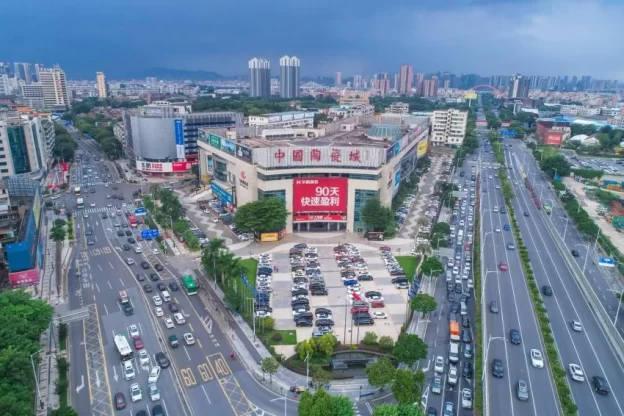

When most overseas building materials wholesalers and engineering contractors first explore the Chinese supply chain, their initial instinct is usually to visit the Canton Fair or search for trading companies online. However, once your purchasing volume reaches a certain scale—such as a full container load—my recommendation is to consider visiting China’s building materials capital in person: our city, Foshan, Guangdong Province.
Foshan and its surrounding supply chains account for a decisive share of the world’s annual architectural ceramics and sanitary ware manufacturing and R&D. Yet, overseas distributors often fall into a common misconception, assuming Foshan is like Yiwu with one single, monolithic “mega-mall.” In reality, Foshan’s wholesale system is an expansive ecosystem comprising international exhibition centers, standalone corporate headquarters clusters, bulk ready-stock distribution hubs, and peripheral aluminum and hardware industrial belts.
If you go to the wrong market, you will not only miss out on competitive pricing, but you may also waste days of valuable time. I am Mr. Tan, a sourcing agent based here in Foshan. In this article, I will combine the latest industry realities and practical data to give overseas distributors a detailed breakdown of the positioning of Foshan’s core wholesale markets, as well as how to navigate the entire sourcing, quality inspection, and container consolidation process.
1. Positioning of Foshan’s Core Building Materials and Ceramics Wholesale Markets
Foshan’s ceramic trade hubs are mainly distributed across Jiangwan Road, Jihua West Road, and Nanzhuang Town in Chancheng District. Merchant profiles, service capabilities, and minimum order quantities (MOQ) vary significantly across different markets, meaning you need to match them precisely to your sourcing requirements.
1. China Ceramics City (CCC)
- Location: No. 2 Jiangwan 3rd Road, Chancheng District (Shiwan core area)
- Market Type: Long-established export flagship window; premier stop for international buyers
- Core Categories: Mid-to-high-end wall and floor tiles, contemporary rustic tiles, marble-look tiles, smart sanitary ware, artistic mosaics.
- Practical Breakdown: This is Foshan’s most mature mall-style exhibition venue for international trade, hosting around 200 export-oriented brands. The English proficiency of booth staff is generally high, they are well-versed in international settlement procedures, and most products carry the certifications required for overseas customs clearance (such as CE for the EU, WaterMark for Australia, SASO for Saudi Arabia, etc.).
- Mr. Tan’s Sourcing Advice: If you run a mid-to-high-end showroom, purchase for a boutique retail chain, or are visiting Foshan for the first time with language concerns, make this your first stop. While quotes here include a certain premium for branding and service, communication costs are the lowest, sampling is standardized, and compliance risks are minimal.
2. China Ceramics & Sanitaryware Industry Headquarters (CCIH)
- Location: No. 68 Jihua West Road, Chancheng District (Intersection of Jihua West Rd & Zidong Rd)
- Market Type: Factory global marketing headquarters; R&D base for premium sintered stone and textured tiles
- Core Categories: 1200×2700mm / 1600×3200mm extra-large sintered stone slabs, micro-cement textured tiles, soft-touch matte tiles, outdoor thick pavers.
- Practical Breakdown: Covering over 400 acres, this complex houses the global marketing centers and standalone pavilions of hundreds of major ceramic enterprises. This is not a collection of small retail stalls; it is where large manufacturers showcase their latest capabilities. Showrooms feature deeply integrated, real-scenario spaces where the latest industrial techniques debut first.
- Mr. Tan’s Sourcing Advice: This venue suits two types of buyers: large-volume importers seeking reputable factories for OEM/ODM private labeling, and commercial project contractors looking for high-end sintered slabs and innovative surface materials. You can negotiate directly with factory export directors, but order quantities typically start at full container loads, making it unsuitable for small-batch stock purchases.
3. Huaxia Ceramics Expo City (Nanzhuang)
- Location: Taobo Avenue, Nanzhuang Town, Chancheng District
- Market Type: The world’s largest bulk ceramic distribution hub and supply chain center
- Core Categories: Full range of glazed polished tiles, rustic tiles, outdoor PC pavers, exterior facade tiles, tile adhesives, and grouts.
- Practical Breakdown: Covering a planned area of over 1 square kilometer, Huaxia is a true commercial powerhouse. It brings together massive pavilions from industry giants (like New Pearl and Shuncheng) alongside factory direct sales offices, trading firms, and large warehousing and logistics yards, handling substantial annual trade volume. The Foshan International Conference & Exhibition Center (Huaxia Hall), one of the main CeramBath venues, is located here.
- Mr. Tan’s Sourcing Advice: For major wholesalers across the Middle East, Africa, Southeast Asia, and Latin America, primary container-load supplies originate mostly from Huaxia and its surrounding areas. Product tiers run deep, ranging from economical mass-volume glazed tiles to high-spec engineering tiles. If your order involves dozens of containers or you need high-volume, cost-effective project tiles, this is your primary destination.
4. Cihai International Ceramic Trading Center
- Location: No. 168 Jihua West Road, Nanzhuang Town, Chancheng District
- Market Type: Design-oriented tiles, niche specialty categories, and artistic ceramics
- Core Categories: Handmade glazed tiles, small-format patterned tiles, wood-look planks, terrazzo tiles, natural stone mosaics.
- Practical Breakdown: Spanning roughly 300,000 square meters, merchants here generally steer clear of cutthroat price competition on standard 600×1200mm or 800×800mm commodities. Instead, they focus on distinctive aesthetic design and specialized dimensions.
- Mr. Tan’s Sourcing Advice: European and North American buyers and boutique hospitality designers often favor Cihai International. If your target market demands unique colorways, geometric patterns, vintage palettes, or small-batch custom blends, this market allows you to bypass large-factory MOQ barriers and connect directly with nimble, specialized manufacturers.
5. Yimeijia Ceramic & Sanitary World
- Location: Intersection of Jihua 4th Road and Wugang Road, Chancheng District
- Market Type: Specialized street-style district for sanitary ware, plumbing hardware, and bathroom furniture
- Core Categories: Bathroom vanity units, smart toilets, thermostatic showers, brassware/faucets, simple shower enclosures.
- Practical Breakdown: Unlike markets primarily focused on surface tiles, Yimeijia focuses directly on bathrooms. It gathers factory offices from Chaozhou, Kaiping, and local Foshan workshops across all price and quality tiers.
- Mr. Tan’s Sourcing Advice: Many buyers procure tiles and bathroom fixtures together. Yimeijia’s central Chancheng location makes it convenient to spend half a day finalizing vanity styles, brassware, and sanitary ware quotes to match your tile shipments.
6. Zhidi Ceramics Wholesale Market / Shagang Warehousing Area
- Location: Zhidi Market and surrounding Shagang village warehouse zone, Shiwan, Chancheng District
- Market Type: Ready-stock trading, commercial bulk inventory, and factory stocklots
- Core Categories: Conventional polished tiles, budget glazed floor tiles, export surplus, discount stocklots.
- Practical Breakdown: You will not find glamorous showrooms here; the area consists mostly of roadside stalls and continuous warehouses. Stall operators maintain direct lines to smaller private kilns in Qingyuan, Gaoyao, or Sanshui, competing purely on immediate availability and rock-bottom prices.
- Mr. Tan’s Sourcing Advice: Best suited for buyers on tight budgets who prioritize unit price over cross-batch consistency. Sourcing here requires rigorous on-site inspection capabilities, as discounted stocklots are almost always sold on a final, non-returnable basis.
7. Strategic Extension: Fengchi Decorative Materials Market (Dali, Nanhai)
- Location: Fengchi Section, Guangfo Road, Dali Town, Nanhai District
- Market Type: China’s largest distribution hub for architectural aluminum extrusions, windows, doors, and hardware
- Core Categories: Thermal break aluminum profiles, heavy-duty sliding doors, all-aluminum cabinetry, structural sealants, and window hardware.
- Practical Breakdown: Foshan is renowned for ceramics, but Dali in Nanhai is equally famous as the “Aluminum Capital of China.” Fengchi houses over a thousand supplier storefronts, backed by mature local extrusion, anodizing, and powder-coating industries.
- Mr. Tan’s Sourcing Advice: Why look at windows and doors when buying tiles? Because during ocean container loading, aluminum doors, windows, profiles, and hardware serve as natural “light and bulky” complementary cargo. Furthermore, Foshan’s aluminum windows and doors enjoy global recognition. Since you are already in town, we recommend taking an extra day to tour Foshan’s window and door industrial belt. Later in this guide, we will explain how combining windows and doors with tiles can significantly cut shipping costs per container.
Further Reading: [How to Import Doors and Windows from China]
2. Quick-Reference Guide: Core Metrics of Foshan’s Major Building Materials Markets
To facilitate quick viewing on mobile devices, here is a summary of the core sourcing parameters for each market:
- China Ceramics City (CCC)
- Core Categories: Premium tiles, integrated sanitary ware, artistic mosaics
- Price Level: Mid-to-high to high-end
- MOQ: Flexible (supports small sample orders and project tailoring)
- Ideal Buyer: International brand agents, boutique building material retailers, buyers prioritizing compliance certifications
- China Ceramics & Sanitaryware Industry Headquarters (CCIH)
- Core Categories: Large sintered stone slabs, micro-cement, tactile textured tiles
- Price Level: Mid-range to bespoke luxury
- MOQ: Relatively high (mostly full containers or custom OEM production runs)
- Ideal Buyer: Importers seeking long-term OEM partnerships, large-scale commercial contractors, regional distributors
- Huaxia Ceramics Expo City (Nanzhuang)
- Core Categories: Complete range of floor tiles, wall tiles, outdoor pavers, installation materials
- Price Level: Budget to mid-range mass volume
- MOQ: Moderate to high (both ready stock and made-to-order available)
- Ideal Buyer: Bulk container importers (Middle East, Africa, SE Asia, Latin America), infrastructure contractors
- Cihai International
- Core Categories: Artistic small tiles, wood planks, terrazzo, custom mosaics
- Price Level: Mid-range designer tier
- MOQ: Flexible (supports multi-SKU consolidated ordering)
- Ideal Buyer: Architectural and interior design firms, specialty retailers, boutique distributors
- Yimeijia Ceramic & Sanitary World
- Core Categories: Vanity units, shower sets/faucets, sanitary ceramics
- Price Level: Primarily mid-range
- MOQ: Moderate
- Ideal Buyer: Dedicated sanitary ware importers, apartment and hotel fit-out contractors
- Zhidi / Shagang Warehousing Area
- Core Categories: Standard commercial tiles, discount stocklots, export surplus
- Price Level: Budget / rock-bottom pricing
- MOQ: Very low (pallet-level purchases from ready stock)
- Ideal Buyer: Price-sensitive traders, economy projects, surplus inventory buyers
- Fengchi Decorative Materials Market (Dali, Nanhai)
- Core Categories: Aluminum doors/windows, architectural profiles, hardware accessories
- Price Level: Factory-direct / highly cost-effective
- MOQ: Flexible (profiles sold by weight, finished units by piece)
- Ideal Buyer: Window fabrication workshops, whole-house fit-out contractors, buyers seeking container consolidation with tiles
3. Quality Control and On-Site Inspection Reminders
Remember: No matter how well your discussions go with a supplier, you must pay close attention to the following points when drafting purchase contracts. These are the exact critical checkpoints our team monitors when inspecting building materials for our clients:
1. Shade and Caliber (Size)
Ceramic tiles are manufactured from natural clays fired at high temperatures; slight physical color variations and thermal shrinkage tolerances across separate kiln runs are inevitable.
- The Batch Rule: Bulk shipments must be locked to the “same kiln, same continuous production run, and same shade/batch number.” Some unscrupulous traders may mix slightly different shade codes on the same pallet when assembling stock orders. Once installed across an expansive job site, these tiles will produce noticeable patchwork discoloration under natural light, resulting in direct commercial claims.
- Flatness and Squareness: Use precision right-angle squares and straightedges to spot-check diagonal deviations, edge straightness, and center warpage (especially on tiles 600×1200mm or larger). If the center curvature of a large slab exceeds standard tolerances (typically controlled within ±0.2%), severe lippage will occur during installation.
2. Shock-Resistant Packaging and Pallet Standards
Tiles are fragile, high-risk items during ocean transit and require strict export-grade packing:
- Pallet Specifications: Pallets must be compliant, sturdy, non-fumigation plywood or solid wood carrying official IPPC heat-treatment stamps. The base must allow smooth 2-way or 4-way forklift entry, with a rated load capacity of 1.5 to 2 metric tons.
- Reinforcement: Heavy-duty corrugated or rigid plastic edge protectors must cover all four vertical corners. Pallets must be wrapped in at least 3 layers of industrial stretch film and bound tightly with PET or composite plastic-steel strapping. When stuffing containers, all voids between pallets must be secured with heavy-duty dunnage air bags to prevent shifting and collapse during rough sea transit.
3. Export Compliance Certifications
Import regulations for ceramics and sanitary ware differ widely by destination country. Do not wait until goods arrive at destination ports to request documentation:
- Europe: Requires a formal Declaration of Performance under EN 14411 (CE marking), supported by mechanical performance test reports from accredited laboratories per ISO 10545 standards.
- Saudi Arabia & Middle East: Requires Saber platform registration and valid SASO/COC conformity certificates prior to dispatch; sanitary fittings must comply with water efficiency labeling schemes.
- Australia / New Zealand: Plumbing fixtures require WaterMark and WELS water-saving compliance; outdoor paving contracts typically require wet pendulum slip test reports (such as P3/P4 ratings).
- North America: Sanitary ware requires cUPC certification, and tiles should satisfy ANSI A137.1 testing standards.
4. Ocean Freight Cost Calculations
International ocean freight makes up a substantial portion of the total landed cost of building materials. The most frequent mistake inexperienced overseas distributors make is filling a 20-foot or 40-foot container exclusively with tiles. Below, Mr. Tan explains why this does not work well, and how to pack a container properly:
1. Physical Limitations: Heavy Cargo vs. Usable Volume
Ceramic tile is a classic high-density “heavy cargo.”
- A standard 20-foot general-purpose container (20GP) provides a theoretical internal volume of around 33 CBM (cubic meters).
- However, highway road transport regulations in most destination countries enforce strict container gross weight limits. For instance, US road weight limits generally cap container cargo at roughly 19.5 to 21 tons, while European and Middle Eastern limits typically range between 24 and 27 tons.
- Deducting the tare weight of the container itself, a 20GP can practically hold only 20 to 26 metric tons of tiles. Converted to surface area, that equals roughly 1,800 to 2,200 square meters of standard 800×800mm glazed porcelain tiles.
- This means that once your 20-foot container hits its maximum allowable weight limit, the physical volume occupied inside is only 15 to 18 CBM—leaving nearly half of the container’s interior space completely empty. You are effectively paying ocean freight on wasted air space.
2. Mr. Tan’s Consolidation Solution: Mix-Loading
To achieve the lowest freight cost per unit, seasoned importers employ a “dense cargo + voluminous cargo” mix-loading strategy:
- Bottom Layer: Place 8 to 12 sturdy pallets of heavy ceramic tiles on the container floor (accounting for roughly 15 to 18 tons of payload).
- Upper Layer: Use the substantial remaining overhead space to load lightweight, high-volume cargo.
- Ideal Mix-Loading Categories:
- Sanitary Ware: Pre-assembled bathroom vanities, lightweight acrylic bathtubs, and wall-hung toilets.
- Doors and Windows: Source matching aluminum thermal break window frames, sliding patio doors, and shower screen profiles directly from the Fengchi Market in Dali, Nanhai.
- Financial Impact: By combining heavy floor tiles with voluminous vanities and window units, goods that previously required two separate containers can often be consolidated into a single 40-foot high cube (40HQ) or an optimized 20-foot container, cutting total ocean freight per square meter by over 20%.
5. Recommended Itinerary for Sourcing Visits
Foshan’s ceramic and building materials industrial belt is vast, and unlike some other cities, the trade is not housed under one single roof or concentrated within one trade hall. We strongly discourage overseas distributors from wandering without a clear plan. If your schedule is limited, we recommend allocating 3 days. Below is a tested itinerary our team previously designed for client visits, which you are welcome to use as a reference:
- Best Time to Visit: Around mid-April or mid-October. These periods coincide with the biannual Foshan CeramBath fair and connect directly with Phase 1 of the Guangzhou Canton Fair (Building Materials and Hardware). Travel between Guangzhou and Foshan takes only 40 to 60 minutes by metro or private car, allowing you to cover the full supply chain in one single journey.
- Day 1: Benchmark Standards & Sanitary Ware Selection Spend the morning at China Ceramics City (CCC) to benchmark current export pricing, sample quality, and international compliance documentation. In the afternoon, head to nearby Yimeijia Ceramic & Sanitary World to select matching bathroom vanities, brassware, and sanitary ware models.
- Day 2: Bulk Sourcing & Factory Negotiations Spend the morning at China Ceramics & Sanitaryware Industry Headquarters (CCIH) touring large brand pavilions and negotiating OEM frameworks for large slabs and standard tiles with export heads. In the afternoon, drive to Huaxia Ceramics Expo City in Nanzhuang to inspect bulk-market pricing, volume manufacturing terms, and surrounding packaging and palletizing yards.
- Day 3: Specialty Lines & Aluminum Consolidation Spend the morning at Cihai International sourcing wood planks, mosaics, and handmade decorative tiles to enrich your showroom offerings. In the afternoon, head to Fengchi Decorative Materials Market in Dali, Nanhai to inspect architectural aluminum systems and hardware, finalizing your lightweight cargo mix for container consolidation.
All the insights shared above are drawn from Mr. Tan’s personal frontline experience and operational track record within this industry. Specific details may naturally vary depending on individual situations, and everyone’s perspective differs; please prioritize your own commercial judgment, using our experience as a practical reference.
On social media, overseas distributors frequently voice the same frustration: “We ordered based on golden samples, but receiving the bulk shipment felt like playing the lottery.” Foshan houses the world’s most efficient and mature building materials manufacturing cluster, but this also means that local factories vary dramatically in their quality control and tolerance standards. When executing major overseas purchase orders, never wire funds based solely on high-resolution product photos or an unverified quotation sheet. If you cannot personally remain in Foshan throughout production, having professional third-party inspectors or an independent local sourcing team monitor critical stages—from kiln runs to pallet packaging and container sealing—remains the most dependable way to guarantee on-time, compliant, and zero-breakage delivery.
As mentioned at the start of this guide, we are a local sourcing and inspection team based right here in Foshan, with our office located in Yanbu, Dali Town. If you require on-the-ground support, feel free to click the WhatsApp button at the bottom right corner of this page to connect with us. Whatever your sourcing requirements may be, we are always open to discussion.
📝 Personal Note From Tan:
Thank you for reading this article, and I hope it has been helpful to you!
My name is Tan, from Guangdong Province, China. I am a sourcing agent and also operate a dropshipping fulfillment service. If you are looking for a private agent in China for long-term cooperation, you can check out my [ABOUT ME] page.
As stated at the top of my website, I am an independent agent. I strictly stick to my work principles: I firmly refuse any kickbacks or commissions from suppliers, and I always stand on the side of overseas buyers!