Zero Factory Kickbacks And Full Transparency Are My Core Advantages.
HOME/Sourcing knowledge/Private Dropshipping Agent vs. AliExpress: A Real Cost Breakdown at 5, 30, and 100 Orders/Day
Private Dropshipping Agent vs. AliExpress: A Real Cost Breakdown at 5, 30, and 100 Orders/Day
By Mr. Tan·Independent Sourcing Agent in Foshan·11 min read
Yesterday, I spoke with a Shopify seller based in the United States. Based on our conversation, I decided to write a series of articles breaking down the real relationship between AliExpress and the dropshipping industry. Using my hands-on experience and the latest available market data, I will put together these insights. For today’s first article, I want to discuss how to make the most cost-effective choice between a private dropshipping agent and AliExpress across different daily order volumes.
If you search “Private Dropshipping Agent vs AliExpress” on Google right now, almost all the top-ranking articles feed you the same boilerplate pitch: AliExpress is slow, private agents are fast, so you should hire an agent immediately. But as a sourcing and fulfillment agent based in Foshan, Guangdong, China—spending most of my time running between Pearl River Delta factories and 1688—Mr. Tan is here to pour some cold water on that idea:
If your store is currently only doing a few orders a day, or if you are still in the product testing phase, you do not need a private agent. At this stage, bringing in an agent will only add operational and time costs to your business, while saving you virtually no money.
However, if you are already consistently pulling 20 to 30+ orders a day and still fulfilling through AliExpress via DSers or AutoDS, the net profit you are throwing away each month might exceed your entire testing ad budget.
This article skips the generic industry fluff. Mr. Tan will use hard data to show you exactly how much AliExpress sellers mark up your products, and where every single cent actually goes at 5, 30, and 100 orders per day.
1. How Much Are AliExpress Sellers Actually Marking Up Your Products?
Many overseas sellers have a misconception that buying on AliExpress means sourcing directly from China’s factory floors. To tell you the truth, at least 85% of the stores on AliExpress selling daily essentials, hardware tools, home goods, and apparel have nothing to do with the source. They are neither manufacturers nor first-tier wholesalers; they are middleman trading outfits operating out of office buildings or residential apartments.
What they do every day isn’t much different from what you do: when you place an order on AliExpress, they turn around and order the item from China’s domestic wholesale platforms (like 1688) or local wholesale markets, pack it, slap a shipping label on it, and send it out.
To stay profitable, an AliExpress seller (reseller) must add a 30% to 60% gross margin on top of their domestic procurement cost to cover several unavoidable overheads:
AliExpress Platform Fees (5%–8%): According to the official AliExpress fee schedule, the platform takes a 5% to 8% category commission directly off every completed transaction (including shipping).
Affiliate Marketing Commissions (3%–9%): Many dropshippers use cashback plugins or affiliate links when placing orders, and these commissions are deducted directly from the AliExpress seller’s account.
Exchange Rate and Withdrawal Losses: In the second half of 2026, the USD/CNY exchange rate hovers around 6.67. With RMB appreciation and cross-border settlement fees, AliExpress sellers typically calculate their USD pricing using a defensive exchange rate of 6.4 or lower to protect their margins against currency fluctuations.
Customs and Clearance Risk Premiums: As duty-free thresholds for small parcels (such as the US Section 321 de minimis exemption) face tightening and customs clearance models undergo stricter compliance worldwide, direct-to-consumer parcels must travel via compliant commercial channels that include prepaid duties (DDP). Most individual AliExpress sellers do not calculate HTS code tax rates SKU by SKU; their approach is simple—they pad an extra $2 to $4 into the product price or shipping fee as a risk cushion.
Therefore, what you see on AliExpress as a “free shipping package” essentially equals: Factory Price + Logistics + Taxes & Duties + Profit Margin + Platform Fees.
2. The Core Difference in Billing Logic Between the Two Models
Why is the final cost completely different when shipping the exact same product from China to an overseas address through a private agent versus AliExpress? Because the underlying billing formula changes entirely.
1. AliExpress Uses “Black-Box Pricing”
On AliExpress, product costs and shipping fees are bundled together as discussed above. The most punishing scenario occurs with multi-item orders. For instance, if you run a bundle promotion on your store (“Buy 2, Get 10% Off”) and a customer orders two units of the same item, the AliExpress checkout (even on AliExpress Choice) typically multiplies the shipping and duty markup by two. In reality, both items go into a single shipping bag, meaning the base registration fee and customs processing cost only occur once.
2. Private Agents Use “Cost-Plus Transparency”
I cannot speak for every private agent out there, but at Mr. Tan’s operation, this is strictly enforced. I do not mark up product prices, nor do I mark up international logistics. In fact, I actively encourage clients to bring their own suppliers to work with us. Every single fulfillment invoice is broken down into four verifiable line items billed at actual cost:
Total Landed Cost per Unit = Source Factory Price + Domestic Inbound Shipping + Special Line DDP Shipping (Actual Weight) + Transparent Service Fee (Tiered)
3. Real Profit & Loss at 5, 30, and 100 Orders/Day
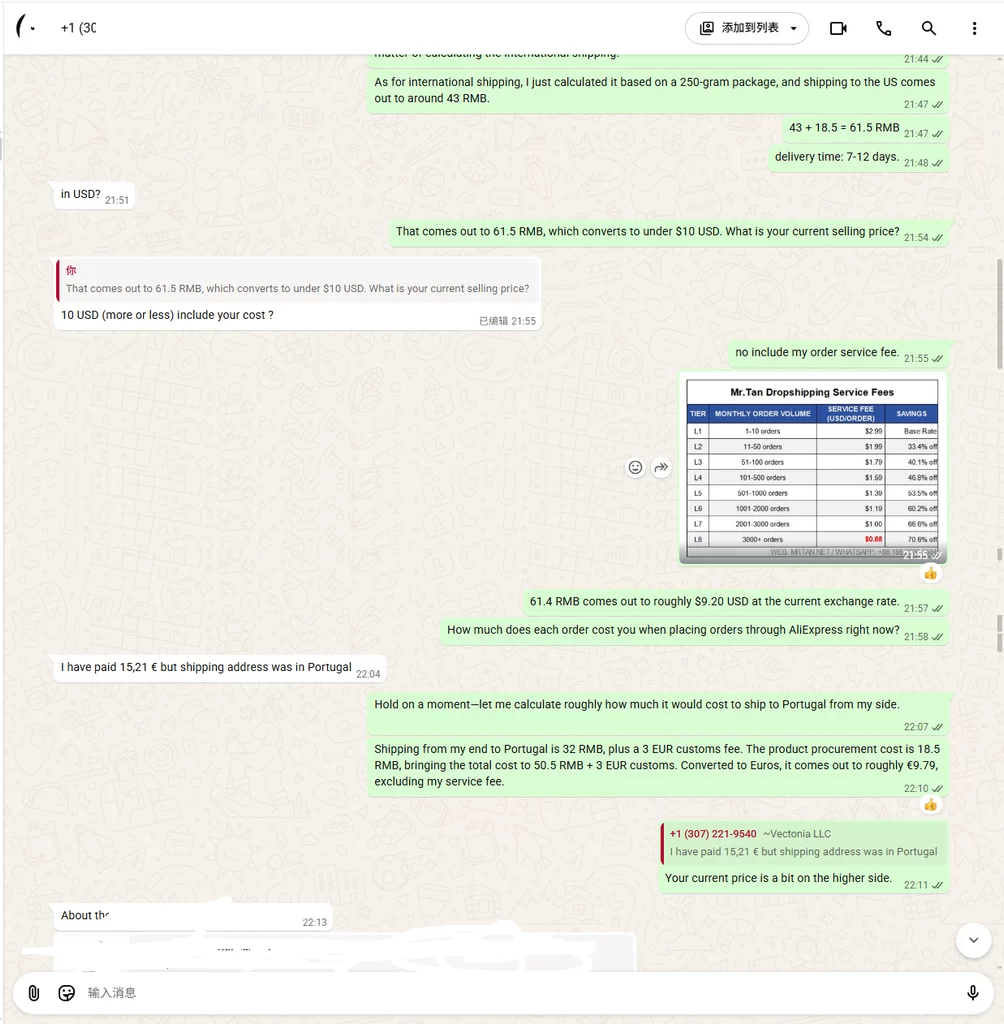
Logic alone isn’t enough. Taking the US Shopify seller I spoke with yesterday as an example, let’s look at a side-by-side comparison using this client’s real numbers.
International Special Line (DDP): 32 RMB + €3.00 customs clearance fee per order
Order Service Fee: Tiered pricing, down to $0.88/order (covers unboxing inspection, removal of factory promo material, system label generation)
Total Landed Cost (1 Unit):€9.79 (excluding order service fee)
Multi-Item Cost (2 Units Bundled):€15.07 (bundle waives secondary base handling and customs fees, billing only for the added weight)
Actual Profit Difference per Order:
Based strictly on single-unit orders, the client saves €4 to €5 per order. Because we do not have verified figures for what AliExpress charges this specific client for a two-unit bundle, we will not speculate on bundle savings.
Now, let’s apply this per-order difference across three daily order tiers to see what happens to your monthly cash flow:
Tier A: Under 5 Orders/Day (Testing Phase) — Recommendation: Stay on AliExpress
Total Monthly Volume: Approximately 100–150 orders
Monthly Margin Difference: Approximately €400–€700 / month
Why I advise you not to switch yet:While saving a few hundred euros a month sounds nice on paper, your product has not yet achieved proven stability at this stage. Working with a private agent requires arranging small-batch inventory with the factory (typically a 3-day buffer stock to speed up dispatch and prevent daily stockouts). You also need to invest time integrating Dianxiaomi ERP and maintaining a prepaid balance. If you are willing to manage these operational tasks yourself, you can certainly capture that €400–€700 in savings.
Actionable Advice: If you are doing fewer than 5 orders a day, stick with DSers and AliExpress. Absorbing a small markup on AliExpress is safer than tying up cash in inventory before your ads are fully validated. Focus your energy on creative optimization and landing page conversions.
Tier B: 30 Orders/Day — The Must-Switch Threshold
Total Monthly Volume: 900 orders (modeled strictly on 1 unit per order)
AliExpress Total Monthly Spend: €13,689
Private Agent Total Monthly Spend: €8,811 + $1,251 (Order service fee: tiered at $1.39/order)
Monthly Net Savings:€3,754 / month
What happens at this stage:Hitting 30 orders a day means your ad campaigns have gained traction and you are ready to scale. At this volume, the few extra euros AliExpress charges per package add up to thousands of euros in pure margin loss every single month. More importantly, at 30 orders a day, we source from factories in cartons of 100–200 units. The factory price drops, domestic freight spreads out to just a few cents per piece, and inventory turns over every 3 to 5 days with minimal capital tie-up. The actual savings end up well beyond the €3,754 calculated above.
Tier C: 100 Orders/Day
Total Monthly Volume: 3,000 orders
AliExpress Total Monthly Spend: €45,630
Private Agent Total Monthly Spend: €29,370 + $2,640 (Order service fee: tiered at $0.88/order)
Monthly Net Savings:€13,887 / month
The Hidden Upside of Scale:Once you reach 3,000 orders a month, we no longer place orders through standard 1688 listings. I will contact the factory owner directly on your behalf. If the manufacturer is located within our Pearl River Delta region, I drive straight to their workshop to negotiate tiered ex-factory pricing, which typically cuts another 5% to 10% off the wholesale list price.At this stage, you aren’t just saving over €10,000 every month—you are protecting your payment processors (PayPal / Stripe). If you run 100 orders a day through AliExpress and a seller runs out of stock, uploads a fake tracking number, or triggers a 5% dispute rate due to delivery delays, your funds can be locked up overnight. That is a risk money cannot easily fix.
4. What Does the Order Service Fee Actually Cover?
Aside from direct cost reductions, the question clients ask most often is what services are actually included in our order processing fee.
When you order on AliExpress, the seller simply forwards a package from point A to point B. Most sellers have never even laid eyes on the physical package. When you partner with Mr. Tan’s private agency, three operational standards are clearly defined:
Unboxing Quality Inspection: Factory production quality varies. While manufacturers do their own checks before shipping, defective units still slip through; even reputable factories have a 1% to 3% defect rate (scratches, missing accessories, incorrect dimensions). When goods arrive at my warehouse, our first step is unboxing to inspect appearance, verify counts, and test basic functionality. If a defect is found, we return it to the factory for a replacement that same day, ensuring defective products never reach your overseas customers to cause bad reviews and chargebacks.
Removal of Promotional Materials: Many domestic Chinese factories ship goods in boxes printed with Chinese company names, quality certs, or WeChat QR codes. AliExpress Choice often ships directly in branded AliExpress mailers. In our warehouse, we strip away all domestic Chinese tags and inner labels, replacing them with neutral packaging materials (supplied at direct factory cost on an as-needed basis). If you have custom branded thank-you cards, we insert them into each package free of charge.
Fulfillment Timeliness: As long as buffer stock is available in our warehouse, orders sync automatically from your Shopify store via Dianxiaomi ERP. Packages are consolidated, packed, and handed over to the courier the same day. Within 24 hours of courier pickup, real tracking numbers sync back to your store dashboard. No fake tracking numbers, and no scenarios where a label sits stagnant for seven days without moving.
5. Rational Assessment: Should You Contact Mr. Tan Right Now?
One of my favorite traditional Chinese sayings is: “Clumsy Sincerity Is Better Than Clever Deceit” (巧诈不如拙诚). I do not believe in making unrealistic promises to win trust or secure orders, and I have no interest in wasting anyone’s time.
If you meet at least two of the following three criteria, you are welcome to reach out to me anytime:
Your store is currently pulling 5+ consistent orders a day, and you are looking for a more dependable supply chain to prepare for scaling;
You are tired of arbitrary price hikes and sudden stockouts from AliExpress sellers, or you want your delivery times to North America and Europe stabilized within a dependable window;
You value a completely transparent business model where all factory prices and shipping bills are settled at actual cost, and I earn only an agreed-upon service fee.
If you are already generating sales and want to know how much your current products are marked up on AliExpress, send your product details and primary destination country directly to my WhatsApp. I will send you real screenshots of the source factory prices alongside current special-line shipping rate sheets. Whether we work together or not, getting your numbers sorted out is always the right first step.
There are three articles in this series in total, or you might be interested in checking out the other two:
Thank you for reading this article, and I hope it has been helpful to you!
My name is Tan, from Guangdong Province, China. I am a sourcing agent and also operate a dropshipping fulfillment service. If you are looking for a private agent in China for long-term cooperation, you can check out my [ABOUT ME] page.
As stated at the top of my website, I am an independent agent. I strictly stick to my work principles: I firmly refuse any kickbacks or commissions from suppliers, and I always stand on the side of overseas buyers!