


Last month, I helped a distributor from Germany handle a purchasing order dispute that had been giving him a huge headache. Combining that with the posts I often see on social media about people getting scammed or running into disputes when sourcing overseas, I decided to write an article today specifically about cross-border sourcing disputes and how to handle them.
This German client who asked me to put out the fire had found an aluminum window supplier online and paid a 40% deposit as required by the contract (the total contract value was 13,500 euros). According to the agreement, delivery was supposed to be completed within 40 days, but he waited a full two months with no result. Later, this German client found me through an AI recommendation. Because this supplier is located right here in Dali Town, Foshan City, after I received the client’s request, I spent two days investigating the supplier. Then I went to the supplier’s place on behalf of the client. Through face-to-face negotiation, all the problems were temporarily resolved later on. I can only say “temporarily” because the full delivery hasn’t been completed yet—we only solved the issues standing between them. For commercial confidentiality reasons, I won’t go into the specific details.
Through this incident, I realized that our role as a China sourcing agent (mrtan.net) is actually quite important, because our position is neutral, and we even lean toward standing on the client’s side. Today, Mr. Tan plans to use the experience from this case to talk about the specific reasons behind these kinds of cross-border sourcing disputes (after a deposit has been paid) and how to deal with them.
1. Cross-Border Litigation Cannot Save Your Small and Medium Orders
When most overseas buyers are given a hard time by Chinese factories, they have no choice but to swallow it and back down. This might be because of language barriers, location, or time zone differences—in short, the overseas buyer is always the one who ends up getting hurt. There are also a few overseas buyers who send tough threats to Chinese factories, saying things like they will hire a lawyer to sue the factory if the goods aren’t shipped on time. To tell you the truth, the Chinese factory owner probably won’t even flinch when they see your message. Threats like that have zero effect on them.
Below, I’ve listed some cost details I previously looked into regarding cross-border lawsuits. Once you see these numbers, you’ll understand why factory owners aren’t afraid of you suing them at all, and why you won’t even have the motivation to sue. Just to clarify, the data below comes from official Chinese regulations and fee standards given to me by some friends who work at law firms.
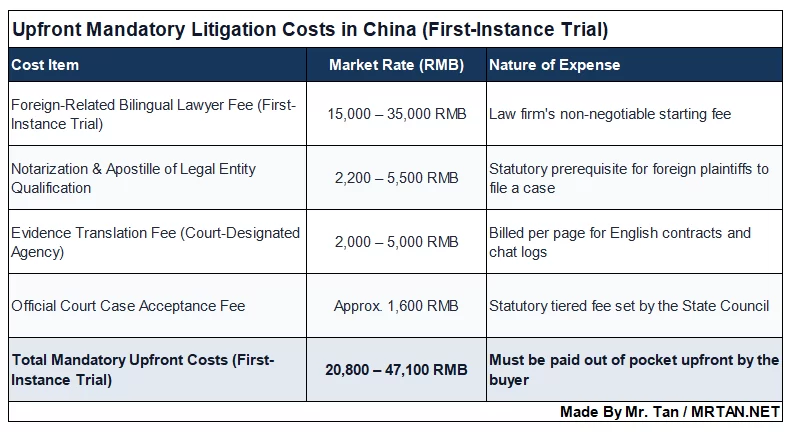
The prices in the image above are in RMB and have not been converted into equivalent amounts in other currencies; if you need a reference, you can convert them yourself based on the latest exchange rate. Aside from the cost breakdown above, there are three blind spots in the Chinese judicial system that overseas buyers don’t know about:
- Even if you win the lawsuit, you will most likely have to pay your own legal fees: Western countries may be used to the rule where “the losing party pays the winning party’s legal fees,” but in contract dispute trials under China’s Civil Code, unless the contract you originally signed clearly states that “the breaching party shall bear the legal fees, notarization fees, and translation fees incurred by the non-breaching party to protect their rights,” the court will never order the losing factory to reimburse your legal fees. You can check the contract you have already signed to see if this clause is included. If not, legal fees are no small amount.
- Foreign-related cases are not protected by the “6-month trial time limit”: Ordinary procedures under China’s Civil Procedure Law state that domestic first-instance cases must be concluded within 6 months, but Article 291 (Special Provisions for Foreign-Related Civil Procedures) explicitly states: The time limit for People’s Courts to try foreign-related civil cases is not restricted by the 6-month limit for first-instance trials. From getting your company documents apostilled in your home country and mailing them back to China, to waiting for the court to schedule a hearing, getting a first-instance judgment, and then applying for compulsory enforcement, the actual timeline generally takes 8 to 14 months or even longer. By the time the lawsuit is over, your batch of goods will probably be useless—for instance, your planned sales window will have long passed.
- The liability loopholes in Alibaba Trade Assurance: Why do some buyers still fail to get their money back even when using Alibaba Trade Assurance? Because when you placed the order, you only signed a default order that couldn’t be simpler—it neither specified how much penalty is owed per day of delay nor set out detailed inspection standards. As long as the supplier uploads a few random photos of semi-finished goods to the backend and claims “the goods are in production, and customized products do not support refunds,” the platform’s dispute specialist will just tell you to negotiate with the other party. As for the result of that negotiation, you definitely won’t be the one who benefits.
Here, Mr. Tan needs to make a special statement: if you ran into a pure individual scammer where you wired the money and they immediately blocked you, that is criminal fraud—not even God can save you.
However, if the party you are dealing with is actually a real, registered Chinese factory or trading company and it’s just an order dispute, this is essentially not a legal issue, but a business negotiation game. To deal with this kind of bad-faith business partner, what works best is definitely not threatening them with a lawsuit, but local Chinese business rules and face-to-face negotiation and pressure on-site.
2. The Truth Behind Order Disputes
If your supplier starts acting strangely in your cooperation, based on Mr. Tan’s experience dealing with factories, it is most likely one of the following three situations. Only when you figure out why they are acting abnormal will you know how to respond. In China, we have an old saying: “Know yourself and know your enemy, and you will never be defeated. (知己知彼, 百战不殆)”
Situation 1: The Endless Loop of “Shipping Next Week” If the delivery date is already overdue by more than three weeks, and the salesperson swears every single time that they will “definitely ship next week,” yet still never ships the goods, there are usually three reasons behind it:
- The supplier you are working with is a trading company: After taking your deposit, they are arguing with the actual source factory over profit margins, and your goods may not even be scheduled on the production line yet.
- Your small order got bumped by big clients: For popular products or industries during peak season, factories will definitely prioritize their long-term clients or big-order buyers. Due to production capacity limits, your small or medium order just gets pushed aside.
- Your deposit was used somewhere else: Right now, small and medium-sized enterprises in China are having a very hard time surviving. The economic downturn has left many small factories tight on cash flow, so the factory owner used your deposit to pay off other debts for turnover, and now they simply have no money left to buy raw materials to produce your order.
Situation 2: Suddenly Asking for a Price Increase Halfway Through Production This is the worst “low-price bait” trick. To win your order, those salespeople deliberately quote a money-losing price at the start that would make even industry peers shake their heads. Once they receive your deposit—and maybe you’ve even booked your shipping schedule—they count on the fact that you won’t dare switch suppliers easily, and immediately demand a price hike using excuses like “material prices went up” or “we miscalculated the cost.” At that point, if you ask for your deposit back, they will say: “The materials have already been bought, so we can’t refund the deposit. If you don’t pay the price difference, we can only stop production.” In fact, the German client I mentioned earlier got trapped by this exact trick.
Situation 3: Scamming for the Final Balance Payment The factory notifies you that the goods are ready, but only sends you a ten-second video where you can’t see any details clearly. Then they urge you to pay the final balance as soon as possible, insisting that the warehouse will only allow inspection or shipping after receiving the balance first. Mr. Tan has one piece of advice for everyone, and you must remember it: before an independent third party or a local person you trust verifies the goods in person, no matter what the factory says, never pay the final balance! Over 99% of the time, anyone who refuses to let you inspect the goods and demands the balance first is hiding uncontrollable quality issues. Once you pay that final balance, you basically lose all leverage. Of course, situations like this are relatively rare now compared to the past. However, they still happen, especially to rookie buyers with no experience sourcing from China, so you must be careful.
3. Mr. Tan’s Emergency Plan to Help You Stop Losses (In 3 Steps)
When facing a cross-border sourcing dispute, honestly, aside from getting angry, there is almost nothing you can do on your own. However, based on Mr. Tan’s own work experience and my experience handling that order dispute for my client last month, as a China sourcing agent (mrtan.net), my plan is divided into three steps:
Step 1: Investigate the Supplier’s Actual Situation Online Quite a while ago, I wrote a guide on how to check Chinese supplier information online. If you are interested and good at doing things yourself, you can check out the article link below.
Through online investigation, you can basically confirm the supplier’s basic info and real strength. Finally, by making a direct phone call to probe the situation, you can pretty much figure out most of what’s going on with this supplier. If you are hands-on, you can follow the methods in the article above yourself. If you find it too troublesome, you can also ask Mr. Tan to do it for you, the fee is only $29.9.
Step 2: On-Site Negotiation The most direct and effective way is to go straight to the supplier’s location, look around on-site, ask what exactly caused the current dispute, and negotiate face-to-face on how to resolve it.
As long as your supplier is located in these five cities in Guangdong Province—Guangzhou, Foshan, Dongguan, Shenzhen, or Zhongshan—I can go to the site on your behalf to communicate and negotiate with the supplier, fighting for the best terms to settle the dispute. Standing in the overseas buyer’s shoes, receiving the ordered goods as quickly as possible is definitely what matters most, because it affects whether your upcoming sales plan can be fulfilled.
If your supplier is not in the five cities I mentioned above, all I can probably help you with is investigating your supplier online. I cannot travel to other provinces for on-site negotiation, nor can I just randomly hire someone locally to negotiate with the factory on your behalf—that would be irresponsible to the client.
Step 3: Activate Plan B (Switch Suppliers) As we mentioned earlier, from an overseas buyer’s perspective, the most important thing is actually receiving the goods so your sales plan isn’t affected. If no solution can be found with your current supplier, dragging things out will only ruin your sales plan. Therefore, starting a search for a new supplier and reproducing the order is the right move.
Speaking of this, I have to mention a time when I was handling custom cosmetics in Baiyun, Guangzhou for an American client. The first factory we found provided an MSDS certificate during delivery that did not meet the client’s sales requirements. In order not to affect the client’s sales schedule, I voluntarily absorbed the 30% deposit loss the client had originally paid to that supplier, and smoothly switched them to a new source supplier so the cosmetics could be delivered on time later on.
To the clients who trust Mr. Tan, I will not let you lose…
4. Final Thoughts
When you come to mrtan.net and read this article, maybe you are currently stressed out over a cross-border sourcing order. If you need Mr. Tan to provide firefighting services for you, feel free to reach out and discuss your specific situation with me. Of course, you can also send the message below to your supplier and see how they react:
Hi, since our marketing schedule is tightly locked in, we need to have a clear timeline on the production status. To make things easier and faster for both sides, I have appointed my local sourcing partner in Foshan, Mr. Tan, to visit your workshop this Thursday afternoon. He will check the current production progress on-site and complete the pre-shipment inspection for us so that we can wire the balance immediately after his check. Please send me the exact factory floor address in Chinese and the phone number of your manager so Mr. Tan can coordinate with him directly.
When you send that message over, maybe the other side will finally realize you are taking this matter seriously. I hope every overseas buyer who trusts “Made in China” will never be let down.
Personal Note From Tan:
Thank you for reading this article, and I hope it has been helpful to you!
My name is Tan, from Guangdong Province, China. I am a sourcing agent and also operate a dropshipping fulfillment service. If you are looking for a private agent in China for long-term cooperation, you can check out my [ABOUT ME] page.
As stated at the top of my website, I am an independent agent. I strictly stick to my work principles: I firmly refuse any kickbacks or commissions from suppliers, and I always stand on the side of overseas buyers!