
Many US independent store and Shopify sellers have likely run into two common traps when it comes to logistics: either falling for an agent’s unrealistic promise of “5-day delivery”—only for customers to wait over two weeks while chargebacks and bad reviews tank the store—or getting nickel-and-dimed by hidden shipping markups that eat away all net margins.
In cross-border dropshipping, transparent math and honest delivery estimates beat flashy marketing every single time. I am MR. TAN, a China sourcing agent based who also operates a dropshipping fulfillment service. Today, no fluff or sales pitches: our team is laying out the real shipping rules, delivery timelines, and compliance boundaries for shipping from China to the United States, giving overseas sellers a crystal-clear picture of how it actually works.
1. Real Delivery Time Breakdown: Why Do Some Arrive in 8 Days While Others Take Half a Month?
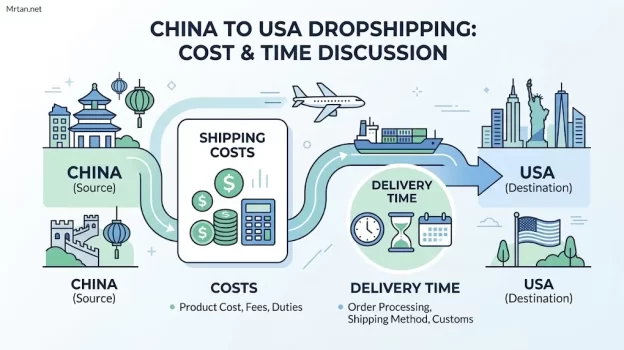
Many service providers only talk about the flight time when advertising their delivery speed. That is misleading. For an end customer, the timeline starts the moment they pay on your storefront and ends when the package lands on their doorstep. This entire process must be broken down into two distinct phases:
Phase 1: In-House Fulfillment & Domestic Procurement (MR. TAN Warehouse)
The duration of this phase depends entirely on whether you keep inventory at our warehouse:
- With Inventory (Highly Recommended): When a customer places an order, it automatically syncs to our warehouse management system. We inspect, pack, and label the item that same day, and hand it over to the carrier within 24 hours. In this scenario, your total delivery time essentially equals the international transit time.
- Without Inventory (On-Demand / Zero-Inventory Sourcing): When an order comes in, we must first purchase the item from your domestic supplier or factory. Domestic shipping to our warehouse in Foshan, Guangdong typically takes 2 to 4 days. Once received, we inspect and repackage the goods before dispatching them. This means you must add an extra 2 to 4 days on top of the carrier’s estimated transit window.
MR. TAN’s Advice: The Buffer Stock Strategy
Dropshipping does not require tying up hundreds of thousands of dollars in heavy inventory like traditional wholesale. Still, running completely “zero inventory” on winning products is not advisable. In the early testing phase, we fully support single-piece sourcing on demand (as long as your supplier supports 1-piece ordering). However, once a product shows stable daily order volume, we strongly recommend stocking 3 to 7 days of buffer inventory in our warehouse based on your weekly sales. Eliminating that 2-to-4-day domestic lead time is often the single factor that protects your dispute rate and repeat purchase rate.
Phase 2: International Linehaul & US Last-Mile Delivery (Carrier Stage)
Once the package leaves our warehouse and is handed over to our long-term logistics partners, it enters pure transit: air transport from China to a US port of entry, customs clearance, and final delivery to the recipient’s door via local couriers (such as USPS or commercial priority networks).
2. Shipping Channels, Product Attributes, and Compliance Boundaries
Shipping costs and transit times do not exist in a vacuum; they depend directly on what you are shipping and the service tier you select.
a. Three Dedicated Shipping Lines and Official Estimated Transit Times
To support different business phases and store models, we primarily offer three shipping lines to the US:
- Standard Line: Official estimated transit time is approximately 7 to 12 days. This is the primary workhorse channel for most independent brand sellers, delivering the best balance of reliable speed, smooth customs handling, and fast last-mile delivery.
- Economy Line: Official estimated transit time is approximately 9 to 14 days. It takes a few days longer than the Standard Line but comes with lower rates. It is best suited for lower-ticket items, volume sales, or price-sensitive products where maximizing margin is the top priority.
- Express Line: Official estimated transit time is approximately 3 to 7 days. If you have urgent restocking needs, high-ticket items, or customer orders demanding rapid delivery, this line moves the fastest, though shipping costs are substantially higher.
A Realistic Note on Delivery Timelines:
The 7–12 days, 9–14 days, and 3–7 days mentioned above are the standard official estimates provided by our partner logistics carriers. In real-world cross-border logistics, occasional delays of a few days caused by force majeure events—such as random customs inspections, severe weather grounding flights, or airport backlogs during peak holiday shopping periods (like Black Friday and Cyber Monday)—are normal industry occurrences. In cross-border e-commerce, building a realistic buffer into your operational expectations is the healthiest way to run a sustainable business.
b. Core Product Attributes: General Goods vs. Battery-Operated Items
- General Goods (Non-battery): Apparel, home goods, plastics, and standard daily necessities without built-in cells. These clear customs smoothly, have access to the widest flight availability, and offer the lowest freight rates and most consistent transit times.
- Battery-Operated Goods (With Battery): Products containing built-in lithium batteries or low-voltage circuits. These must move through dedicated, fully compliant battery air channels, making shipping costs slightly higher than general cargo.
⚠️ Strict Compliance Red Line: No Replicas or Counterfeits
We strictly do not accept dropshipping fulfillment for any counterfeit, replica, or IP-infringing products.
This is not MR. TAN being picky about clients. Our partner international express carriers maintain zero-tolerance risk controls regarding intellectual property. If unauthorized goods are seized by US Customs, it risks impounding the entire consolidated batch and jeopardizes account standing. Setting this boundary upfront saves everyone valuable time.
3. How Are Shipping Costs Actually Calculated?
Cross-border shipping formulas look complicated on the surface, but once made transparent, the logic is straightforward.
The Pricing Formula: Actual Gram Weight Fee + Registration Fee
The total international shipping cost for a single package consists of two components:
Total Shipping Cost = Weight Fee (Calculated by Actual Grams) + Registration Fee per Parcel
- Registration Fee: A fixed tracking and handling fee charged once per package.
- Billed by the Exact Gram (No Rounding Up): Many freight forwarders round weight up to the nearest 500g or 1kg (for instance, charging a 230g package at 500g). Small, light parcels suffer heavily under that model. With us, everything is billed by the exact gram—your actual weight is multiplied directly by the gram rate, down to the single gram.
Actual Weight vs. Volumetric Weight: The Divisor 8000 Advantage
International logistics operates on the standard rule of “chargeable weight is whichever is greater between actual weight and volumetric weight.” The volumetric weight formula is:
Volumetric Weight (kg) = Length (cm) × Width (cm) × Height (cm) / 8000
Most forwarders divide by 5000 or 6000. Our partner lines calculate volumetric weight divided by 8000. Because the denominator is significantly larger, the resulting volumetric weight is substantially smaller. For lightweight, bulky goods, this single difference significantly lowers chargeable weight.
Free Vacuum Compression Packaging for Bulky Items
Apparel, textiles, and plush items take up space without adding weight, meaning you end up paying carriers to ship air. For these bulky items, the MR. TAN warehouse provides free vacuum compression packaging, physically reducing parcel dimensions to the absolute minimum so you never overpay on dimensional weight.
Why This Article Does Not List Fixed “$/kg” Rates
Any article claiming a fixed rate like “shipping from China to the US is $X per kg” is posting outdated information for clickbait. Aviation fuel surcharges and flight capacities fluctuate weekly, if not daily.
MR. TAN’s commitment: Zero markup on freight, billed at actual cost. Whatever our partner carriers bill us on their updated rate cards is the exact price passed on to you. We do not make profit margins on shipping costs. If you need the latest live shipping rate sheet, contact me anytime.
4. If There Is Zero Markup on Shipping, How Does MR. TAN Profit?
With no shipping markup, a divisor of 8000, and free vacuum compression, the natural question is: how do we sustain our business?
We charge a straightforward, transparent Order Fulfillment Fee:
- Covers warehouse receiving, quality inspection, repackaging (packaging material costs billed separately), label generation/printing, and automated store sync.
- Base handling fees start as low as $1.19 per order.
- We use a tiered pricing structure: higher daily volume means a lower per-order handling cost. Contact MR. TAN directly for the full tiered rate sheet.
Running a successful dropshipping business in the US market comes down to four core operational realities: transit stability, honest weight calculation, meticulous packaging, and complete transparency between partners.
For more operational details regarding our free storage policies, return handling, and store integrations, feel free to check our detailed FAQ page: MR. TAN Dropshipping FAQ. If you are currently testing or scaling a product, send over its dimensions, weight, and product type—I will run a clear, line-by-line cost estimate based on this week’s live shipping rates. Feel free to contact us anytime.
📝 Personal Note From Tan:
Thank you for reading my factory field report. I spent hours on-site at this facility to bring you the unfiltered truth, because I believe overseas buyers deserve absolute transparency.
I am not a giant, cold sourcing corporate. I am an independent, on-demand boots-on-the-ground sourcing agent based right here in Guangdong. I am actively looking for long-term procurement partnerships, and frankly, I need and value this work.
My service fee is highly competitive because I keep my overhead low and refuse any hidden factory kickbacks—I fight 100% for your profit margins and quality protection. If you need someone honest to audit factories, negotiate bottom prices, or oversee production deadlines in China, please read my story on my [ABOUT ME] page or drop me a line directly. Let’s build something real together.