
I often see overseas buyers complaining online: “Finding a Chinese factory on Alibaba or other B2B platforms is as easy as clicking a mouse. But here’s the real nightmare: you have zero idea who is actually sitting behind that computer screen, and whether your bulk order will ever be delivered on time and up to standard.”
Doing cross-border business means dealing with time zones, language barriers, unfamiliar local business rules, and hidden trade traps. When you aren’t physically on the ground in China, things can quickly spiral out of control. That’s why hiring a reliable local China sourcing agent is essentially finding an insider on the ground—someone who can run errands, inspect the factory floor, and negotiate with suppliers on your behalf.
However, the market is flooded with all kinds of agents—some charge exorbitant fees, while others make lofty promises they can’t keep. So, as an overseas distributor, how do you pick the right one? Today, I—MR. TAN—will share some raw, honest truths based on my hands-on experience as a sourcing agent right here in Guangdong, China.
1. The Biggest Pitfalls Overseas Buyers Face When Sourcing from China
Before choosing an agent, you need to understand where buyers get burned the most:
- Thinking You Found a Direct Factory (When It’s Actually Middlemen)Many suppliers advertising as “large-scale manufacturers” on B2B sites are actually tiny trading companies with just a few employees, or factories without export licenses hanging onto third-party permits. An even nastier trap: they produce a flawless golden sample themselves, but once you place the bulk order, they secretly outsource production to a cheap, unvetted sub-workshop. Quality plunges overnight.
- “Golden Samples, Garbage Bulk” — Silent Quality DegradationThe sample sent to your doorstep looks pristine. But during mass production, the factory quietly cuts corners to boost margins—shaving half a millimeter off metal plates or substituting virgin plastic with recycled scrap. If you only discover this after the shipping container arrives at your overseas warehouse, the return shipping costs alone will wipe out your profits.
- “Only Good News” Communication — Hiding Problems Until It’s Too LateThis is a chronic habit among many small suppliers. When production falls behind schedule or a component goes wrong, their first instinct isn’t to solve the problem immediately—it’s to hide it as long as possible, hoping a miracle will happen. On the agreed dispatch date, after you’ve already booked shipping containers, they casually tell you: “Sorry, the goods aren’t ready.”
2. Practical Checklist: How to Evaluate a China Sourcing Agent
When choosing an agent, don’t just listen to flashy sales pitches or chase the lowest fees. Focus on these four core criteria:
1. Are They Physically Located in Your Industry Cluster?
China is huge, and manufacturing is heavily cluster-based. Take Guangdong for instance: Shenzhen and Dongguan dominate electronics; Foshan is the global hub for furniture, tiles, lighting, and hardware; Zhongshan specializes in lighting fixtures. If your agent is based hundreds of miles away from the factory, they might only visit once a month. But if they are right in the heart of the cluster, they can drive to the shop floor in 30 to 60 minutes. That proximity gives them the power to perform unannounced spot checks—and that sheer presence keeps factories honest.
2. Are They a “Message Carrier” or Your “On-Site Guardian”?
Some agents simply forward factory quotes to you, forward your feedback to the factory, and sit back. They are just “message carriers.” When something goes wrong, they throw up their hands and say, “The factory refuses to refund.” A real agent acts as your on-site guardian. They scrutinize factory quotes for red flags, audit production capacity on the floor, and conduct in-process quality control (DUPRO). Ask a prospective agent directly: “If the factory turns out defective goods, what is your exact step-by-step protocol on the ground?” Their answer will tell you everything.
3. Understand the Pricing Model — Never Fall for “Free” Sourcing
Let’s talk about sourcing agent services fees, which every buyer cares about. Truth be told, there’s no free lunch in international trade. Honest sourcing agents typically charge in one of three ways:
- Percentage Commission (Around 5%): The most common model, based on total order value, ideal for small-to-midsize orders.
- Flat Project Fee: Best for one-off product development or finding a specific factory.
- Monthly Retainer: Functions like hiring your own dedicated sourcing office in China, ideal for high-volume, continuous buyers.
Here is a huge trap for overseas buyers: Never hire agents who offer extremely low rates or promise “Free Sourcing Services.” Ask yourself: how does an agent survive without making money? If they don’t charge you a transparent service fee, they are guaranteed to collect heavy, hidden kickbacks from the factory behind your back.
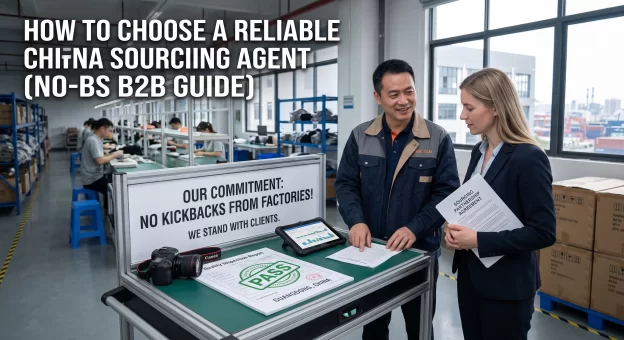
MR. TAN is one of the very few agents who puts “Refusing factory kickbacks and Low MOQ is my core advantage!” right on the most prominent banner of my website. Once an agent starts taking money from the factory, their loyalty shifts completely to the supplier, not you. When quality defects happen or production delays hit, do you really think they will fight for your interests, or will they team up with the factory to hide the truth? Hiring an agent is about finding an insider who stands on your side, protecting your money and product quality. When incentives are aligned, everything runs smoothly. As I put it right on my website homepage: “I stand firmly on the side of the buyer!”
4. Do They Have the Courage to “Stop Shipment” Before Loading?
The worst thing in procurement is letting defective goods ship out. A qualified agent doesn’t take the factory’s word at face value. They understand your local market compliance standards (such as CE, RoHS, FCC), and they verify the factory’s credentials before scheduling production. Once production finishes, they supervise container loading on-site—taking photos, filming videos, verifying carton strength, and optimizing space utilization. Most importantly: If quality fails pre-shipment inspection, do they have the guts to halt loading, withhold final payment, and force the factory to rework the goods before shipping?
Conclusion
For overseas distributors, finding a supplier in China isn’t just about finding products—it’s about finding a trustworthy partner on the ground who can mitigate your risks. By partnering with a local agent who is rooted in manufacturing hubs, completely transparent about pricing, and fearless in standing up to factories for your benefit, you can focus on driving sales in your home market while leaving supply chain headaches in capable hands. That is the safest, most stress-free way to scale your cross-border business.
📝 Personal Note From Tan:
Thank you for reading my factory field report. I spent hours on-site at this facility to bring you the unfiltered truth, because I believe overseas buyers deserve absolute transparency.
I am not a giant, cold sourcing corporate. I am an independent, on-demand boots-on-the-ground sourcing agent based right here in Guangdong. I am actively looking for long-term procurement partnerships, and frankly, I need and value this work.
My service fee is highly competitive because I keep my overhead low and refuse any hidden factory kickbacks—I fight 100% for your profit margins and quality protection. If you need someone honest to audit factories, negotiate bottom prices, or oversee production deadlines in China, please read my story on my [ABOUT ME] page or drop me a line directly. Let’s build something real together.